We combine custom AI integration in software and existing systems with AI Craft, our enterprise offer for strategy, governance, enablement, integration, measurement and operations.
Not every AI initiative needs the same starting point. Some companies want concrete functions in their software; others want to build a controlled AI practice across teams and processes.
Custom AI integration
For concrete requirements in new or existing software: we build AI features, agents and automations around systems, data, roles and user experience.
AI in portals, backoffice and business applications
Connection to APIs, documents, knowledge sources and data flows
RAG, assistant features, workflows and human approvals
AI Craft by codeCrafters
Our flagship for organizations that want to move AI from experimentation into operations: with clear strategy, governance, enablement, integration, measurement and continuous evolution.
Assessment, roadmap and prioritized use-case portfolio
Policies, tool assessment, role programs and AI Champions
ROI measurement, operations, cost control and tool radar
AI without theater: utility, security and adoption
AI creates value only when connected to the right context. That is why we consider processes, data, permissions, users, costs and architecture from the start.
Concrete value
We prioritize use cases with understandable impact, measurable criteria and realistic data conditions.
Real integration
We connect AI to portals, backoffice, document flows, APIs and existing workflows.
Control
We consider privacy, permissions, quality, costs, model behavior and human validation.
AI Craft
The enterprise program for controlled AI in operations
AI Craft combines consulting, engineering, integration, training, security and operations. Companies can start with one module or build a complete program.
AI Craft
Advise Govern Enable
Connect · Build · Measure · Manage
Advise
Assessment, opportunities, roadmap and initial business case.
Govern
Policies, allowed data, tool assessment, security and risks.
Enable
Workshops, playbooks, AI Champions and role-based support.
Connect
MCPs, APIs, authentication, permissions and traceability.
Build
Agents, automations, copilots and AI-augmented software.
Measure
KPIs for adoption, productivity, quality, costs, risk and ROI.
Manage
Support, tool radar, cost optimization and continuous improvement.
One implementation flow
Whether it is a single use case or an AI Craft program, we work step by step so decisions, risks, implementation and scaling stay understandable.
01
Diagnose
Understand maturity, processes, risks, systems, involved teams and possible starting points.
02
Clarify governance
Define policies, allowed data, tools, security controls and human review.
03
Build and integrate
Implement the case with real data, APIs, roles, agents or automations.
04
Enable teams
Support users, business areas, management and technical teams with suitable formats.
05
Measure and scale
Measure adoption, productivity, quality, costs and risks, then derive the next areas.
Role-based enablement instead of a one-size-fits-all workshop
AI adoption works when different groups know how to make decisions, check quality and use tools responsibly.
Executives
Evaluate investments, acceptable risk and clear expectations for each area.
Management and PMs
Redesign processes with AI, steer quality and report progress clearly.
Developers
Apply prompting, agents, MCP, code reviews, tests and security limits in practice.
Business users
Use recurring tasks, documents, analysis and personal assistants in a controlled way.
AI Champions
Build internal contacts who answer questions, carry standards and escalate cases.
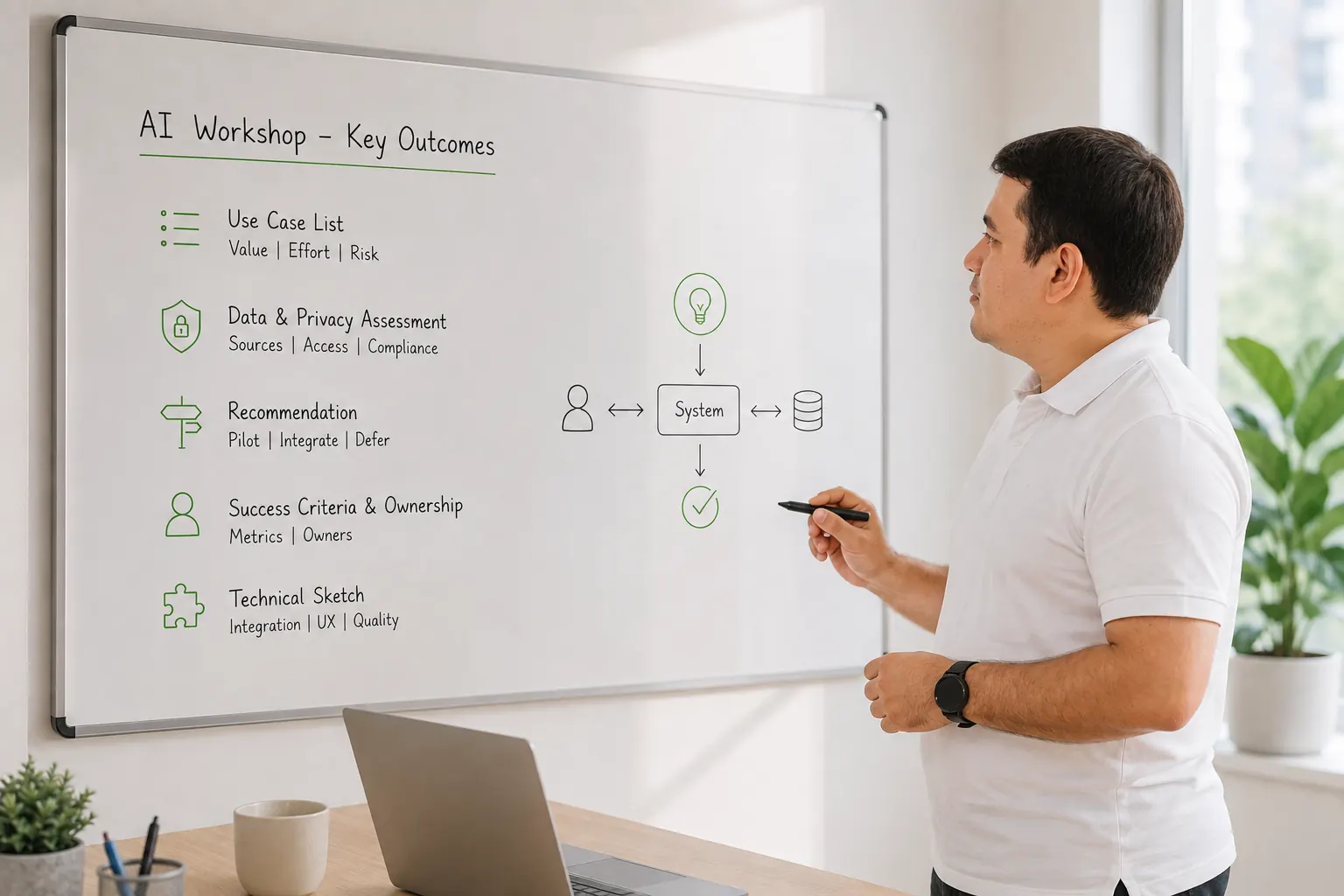
What should be clear after a first AI workshop
A good workshop does not end with inspiration alone. It should produce decisions and a prioritized, testable starting point.
A use-case list with value, effort and risk
Assessment of data sources, permissions and privacy questions
Recommendation for pilot, integration or conscious postponement
Initial success criteria and responsibilities
Technical sketch for system integration, user experience and quality control
Typical use cases
We assess use cases by whether they reduce real work, improve decisions or extend existing software in a useful way.
Knowledge and search
When knowledge is spread across documents, wikis, tickets, files or emails and teams spend too much time searching.
Internal knowledge assistants
Search across company data
Answers with sources and access control
Documents and backoffice
When recurring documents must be read, compared, checked or transformed into structured data.
Document analysis
Information extraction
Support for offers, contracts or forms
Customers and support
When service teams handle many similar requests and still need to maintain quality, tone and control.
Support assistants
Request classification
Suggested responses with human validation
Product and software
When existing portals or tools can become more useful through intelligent features.
AI features in portals
Conversational interfaces
AI-supported development, reviews and tests
Reporting and decisions
When unstructured information needs to be summarized, assessed or prepared for management decisions.
Executive summaries
Reporting agents
Decision support with traceable sources
How we measure AI success
A pilot becomes credible when impact and operations are measurable. That is why we define metrics early and compare results against the baseline.
01
Adoption
Active users, frequency, participating teams and covered use cases.
02
Productivity
Time saved, cycle time, automated tasks and relieved routines.
03
Quality
Defects, rework, reviews, source quality, coverage and incidents.
04
Costs and ROI
Licenses, consumption, infrastructure, support and estimated value by process.
Operations and evolution after launch
When AI is used in production, it needs care: new tools, costs, policies, connectors, agents and user questions keep evolving.
KI bleibt ein laufendes System, nicht ein einmaliger Rollout.
AI Committee
Backlog, prioritization, exceptions, review meetings and next scaling steps.
Tool radar
Assessment of new tools, models, agents and integrations with a clear recommendation.
Support and guidance
Office hours, problem solving, updated guides and role-based support.
Cost control
Keep licenses, consumption, duplicates, quotas and usage by team visible.
Risks we design for from the start
Serious AI projects need technical and organizational guardrails. We plan them early so a pilot does not later fail because of operations, privacy or adoption.
Privacy and permissions
Who may see which data, and how do we prevent AI from answering from the wrong context?
Answer quality
Which answers are acceptable, how are sources shown and when is human review required?
Costs and scale
How do model, infrastructure and operating costs develop under real usage?
Adoption
How are teams enabled, and what rules do they need for responsible AI use?
Start with the right AI question
Whether it is a concrete AI feature, integration into existing systems or AI Craft as an enterprise program: one first conversation is enough to clarify the right starting point.